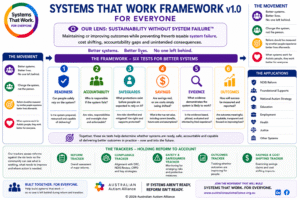
Systems That Work™ Framework v1.0 Better systems. Better lives. No one left behind.
For decades, Australians have worked to improve systems that support people with disability.
The Disability Royal Commission, the Independent NDIS Review, the National Autism Strategy and countless inquiries have all highlighted remarkably similar themes:
· fragmented systems;
· unclear accountability;
· people falling through gaps;
· unintended consequences; and
· reforms that do not always deliver the outcomes they were intended to achieve.
Yet despite this growing body of evidence, there remains no practical framework for asking one simple question:
Will this reform actually work for the people expected to rely on it?
Too often, reforms are judged by their intentions, their funding, or the savings they are expected to generate.
Far less attention is given to whether systems are genuinely ready, whether safeguards are in place, who is accountable if things go wrong, whether costs are simply being shifted elsewhere, and whether people’s lives ultimately improve.
The Australian Autism Alliance developed the Systems That Work™ Framework to help answer those questions.
The Framework did not emerge from a single policy or piece of legislation.
It has been developed progressively through the Alliance’s work across autism, disability and broader systems reform, drawing on lived experience, research, implementation practice, public policy, governance and systems thinking.
Throughout the recent NDIS reform process, the Alliance recognised that many of the challenges being debated were not unique to disability. They reflected broader questions about how governments design, implement and evaluate complex reform.
Rather than responding only to individual policies, the Alliance set out to develop a practical framework that could be applied before, during and after reform to help determine whether systems are genuinely capable of delivering better outcomes.
The result is the Systems That Work™ Framework v1.0.
At its heart is a simple proposition:
People should not have to fight systems just to belong.
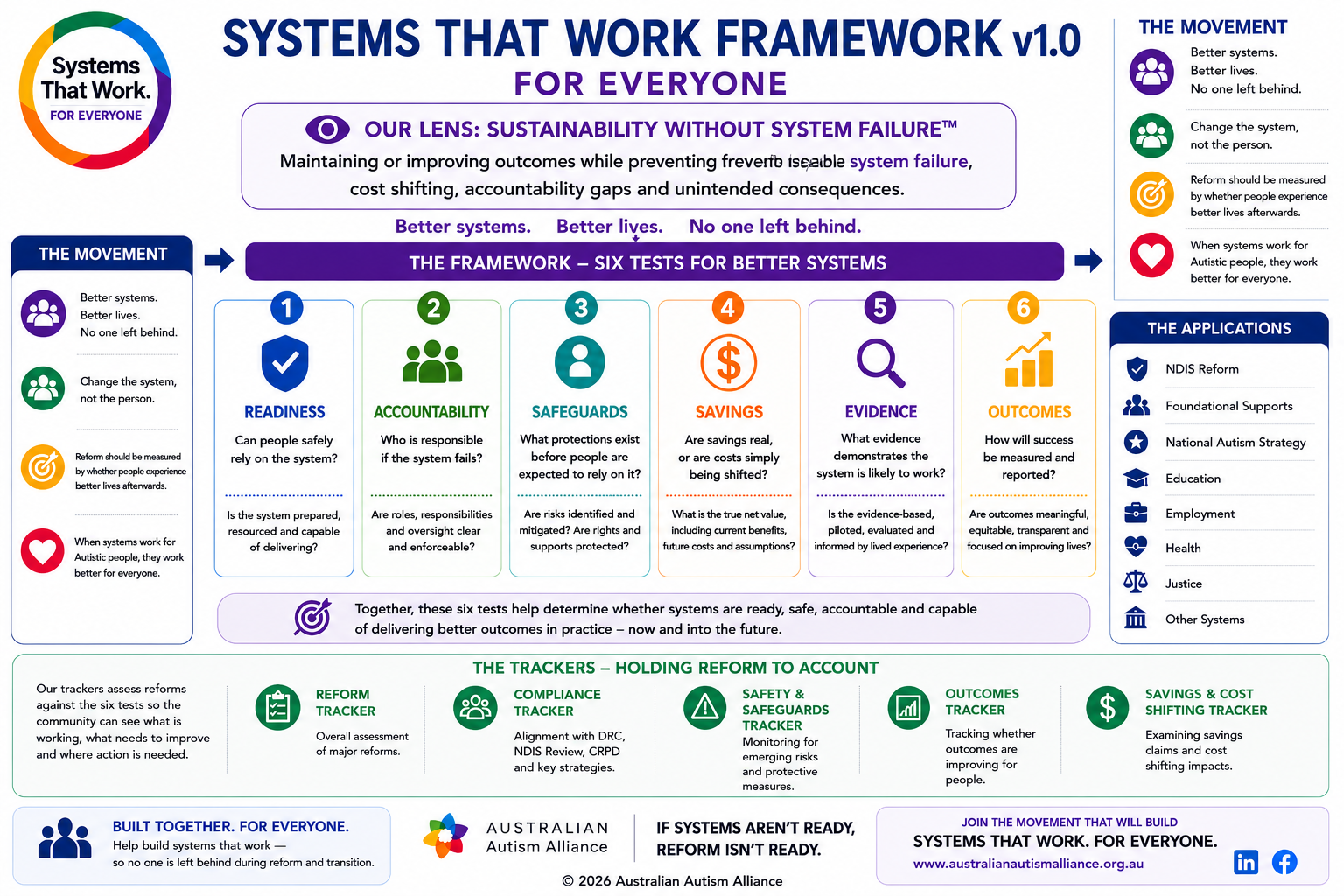
The Framework applies a single overarching lens:
Sustainability without System Failure™
Sustainability should never be achieved by transferring risk, costs or failure onto individuals, families or other systems.
Instead, sustainable reform maintains or improves outcomes while preventing foreseeable system failure, cost shifting, accountability gaps and unintended consequences.
To support this, the Framework applies six practical tests:
- Readiness
- Accountability
- Safeguards
- Savings
- Evidence
- Outcomes
Together these tests help determine whether systems are ready, safe, accountable and capable of delivering better outcomes in practice.
The Framework is supported by practical assessment tools—including the Systems That Work Readiness Index and Systems That Work Accountability Index—together with a growing suite of reform trackers that help monitor implementation, compliance, safeguards, outcomes and cost shifting over time.
Importantly, this is Version 1.0.
We believe better systems are built through learning.
We invite people with disability, families, disability representative organisations, researchers, professionals, and communities to apply the Framework, test it in practice and contribute to future iterations so as to shape future the future of better systems.
Because if systems aren’t ready, reform isn’t ready.
Help Build Systems That Work—For Everyone.